
Table of Contents
- CNC Milling and Casting: Two Different Manufacturing Processes
- CNC Milling vs Casting: The Core Differences
- Solid Bar Stock Golf Tools: Why the Starting Material Matters
- CNC-Milled Divot Tools: Engineering for Performance
- Golf Tool Durability: Real-World Performance
- Cost, Value, and When to Invest in CNC
- Frequently Asked Questions
Last Updated: October 12, 2026
CNC Milling and Casting: Two Different Manufacturing Processes
When you're comparing CNC milled golf tools versus cast alternatives, you're actually comparing two fundamentally different manufacturing approaches, not just different materials or designs.
CNC milling is a subtractive machining process. It starts with solid bar stock and removes material using computer-controlled cutting tools. A CNC machine follows exact digital instructions to shape the blank into a finished tool.
Casting is a forming process. Molten metal is poured into a mold and allowed to cool. Once solid, the casting is removed from the mold. Additional finishing may occur, but the basic shape is set by the mold itself.
The difference between these two processes cascades through everything that follows: precision, material properties, consistency, and ultimately, how the tool performs on the course.
CNC Milling vs Casting: The Core Differences
Understanding what separates CNC milled golf tools versus cast ones requires looking at what each process actually delivers, and where each one falls short.
Manufacturing Precision and Tolerances
CNC milling produces tighter tolerances than casting. A Swiss CNC machine can hold dimensions within a few thousandths of an inch. Casting tolerances are looser because metal shrinks unpredictably as it cools, and mold imperfections transfer directly to the finished part.
For a divot tool, this means a CNC-milled single prong will have consistent geometry from one unit to the next. The angle, the thickness, the taper, all identical.

Tighter tolerances don't just sound better on paper. They translate to consistent performance. If you own two CNC-milled tools, they'll behave the same way in your hand and on the green. With cast tools, you might get variation between units.
Material Consistency and Grain Structure
When metal is cast, the cooling process creates a grain structure that depends on how quickly different sections of the part cool. Thicker sections cool slower than thin ones, producing different grain sizes in different areas. This variation affects durability and how the material responds to stress.
CNC milling starts with material that's already been processed and refined, solid bar stock with uniform grain structure throughout. When you machine it, you're working with material that has consistent properties from center to edge. The grain structure is already stable.
This matters for tools that take repeated impact or stress. A divot tool with uniform grain structure throughout handles consistent use better than one where grain size varies across the piece.
Solid Bar Stock Golf Tools: Why the Starting Material Matters
The choice to start with solid bar stock is a decision that affects everything downstream. It's not just about what you remove, it's about what you start with.
Solid bar stock comes from a supplier who has already refined and processed the material. The alloy composition is controlled. The grain structure is uniform.
This is why aerospace manufacturers and medical device makers use solid bar stock. They need to know exactly what they're starting with. The same logic applies to precision golf tools.
Casting can produce finished parts with less material waste, which is why it's popular in high-volume manufacturing.
CNC-Milled Divot Tools: Engineering for Performance
A CNC-milled divot tool engineered from solid bar stock is built for one specific job: fixing ball marks without damaging the green.
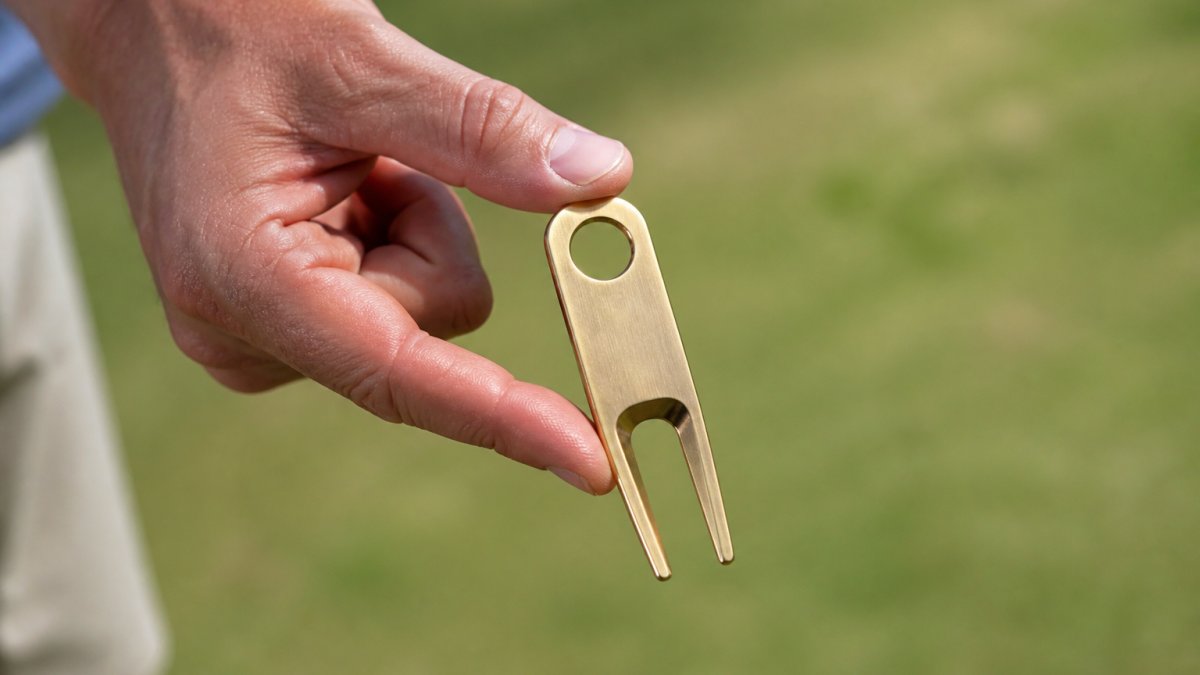
Most divot tools use two prongs that lift the turf. A properly engineered single-prong tool inserts at the edge of the mark, rotates around the perimeter, and restores the surface without lifting or tearing.
The Sunday Birdie Divot Tool is CNC-machined from solid brass or aluminum on a Swiss CNC machine. The design is straightforward: a single prong, 3.5 inches overall length, 0.375-inch body diameter. The lifetime guarantee backs the durability.
This is the difference between a tool designed for precision and a tool that's just another piece of gear in your bag. The weight, the balance, the feel, these come from engineering, not accident.
Golf Tool Durability: Real-World Performance
Durability is what a tool looks like after 100 rounds, 500 rounds, 1,000 rounds. Does the prong still hold its shape? Does the finish still look intact? Does it feel the same in your hand as the day you bought it?
Wear Resistance and Long-Term Use
Solid bar stock has a uniform grain structure because it was worked and refined before it ever reached the machine. When a tool is machined from that stock, the material behaves the same way at the tip of the prong as it does at the body.
Castings cool at different rates depending on section thickness. Thin sections freeze quickly; thicker sections cool slowly. That produces grain-size variation and, in some alloys, porosity, small internal voids that act as stress concentrators.
In practice, this shows up as uneven wear. One edge of a prong may round over faster than the other. A finish may pit in a spot that doesn't correspond to where the tool is actually being used.
Feel and Feedback at Impact
Feel at impact is real, but it's not determined by manufacturing method alone. Four factors drive it:
- Alloy. Brass, aluminum, stainless steel, and titanium each transmit vibration differently. Brass is dense and damped; aluminum is light and lively. This is a material choice, not a process choice.
- Geometry. Prong thickness, taper, length, and the mass distribution of the body all shape how the tool responds when it enters the turf.
- Face and surface treatment. A polished surface, a bead-blasted surface, and a coated surface each change friction and how the tool communicates feedback through your hand.
- Construction. A one-piece machined tool has no joints or seams to introduce play or inconsistency. A multi-piece assembly can develop looseness over time.
Because CNC milling holds tight tolerances, a machined tool can be designed with a specific alloy and geometry and then reproduced unit after unit with the same feel. That's the real advantage: not that machining magically improves feel, but that it makes a chosen feel repeatable.
A cast tool can also feel good, if the alloy and geometry are right. The risk is variation. Two cast tools from the same mold can feel slightly different because of cooling differences, and a single cast tool can change feel as it wears if the wear follows grain boundaries.
What This Means for You
If you want a tool that feels the same every time you pull it out of your bag, the combination that delivers that is a controlled alloy, a deliberate geometry, and a manufacturing process that reproduces both consistently. CNC milling from solid bar stock is one way to get there. Casting can get close, but it introduces variables that machining doesn't.
Cost, Value, and When to Invest in CNC
CNC milling costs more than casting, and it's worth understanding exactly where that money goes before deciding whether it matters for a divot tool.
Where the Cost Actually Comes From
Four cost drivers separate a machined tool from a cast one:
- Machine time. A Swiss-style CNC machine removes metal one pass at a time. Cycle time per part is measured in minutes, and the machine, its tooling, and its operator all cost money during that window. A casting cycle fills many mold cavities at once, so the per-part machine time is a fraction of the machining equivalent.
- Material waste. Subtractive machining turns a percentage of the bar stock into chips. Forming a part in a mold uses only the metal that ends up in the finished piece, plus a small amount of gating and flashing that gets trimmed.
- Setup and programming. Every machined design needs toolpaths, fixturing, and a first-article inspection before production runs. Casting needs a mold, but once the mold exists, the per-part setup cost drops sharply.
- Finishing. Both processes usually need secondary operations, deburring, polishing, tumbling, coating. A casting often needs more of it because the as-cast surface is rougher and parting lines must be removed.
Add those up and the pattern is consistent: casting wins on per-unit cost at volume, and machining wins on control. Neither is automatically "better", they optimize for different things.
Manufacturing Expense Is Not the Same as Golfer Value
The retail price of a tool reflects manufacturing cost plus margin, but the value to you depends on how the tool performs over its life. Those are separate questions, and conflating them is where most comparisons go wrong.
A useful way to think about it: a cast divot tool and a machined divot tool both fix ball marks. The difference shows up in how consistently they do it, how long they hold their geometry, and whether the second unit you buy feels like the first. If those things matter to you, the higher upfront cost can be justified. If they don't, a cast tool does the job.
A Practical Decision Framework
Ask three questions:
- How often do you play? A golfer who plays weekly puts far more cycles on a tool than someone who plays a few times a season. More cycles means wear and geometry retention matter more.
- Do you care about unit-to-unit consistency? If you've ever replaced a tool and felt like the new one behaved differently, that's the variable you're paying to eliminate.
- What's your replacement horizon? A tool that lasts years changes the math versus one you expect to replace every season.
For a regular player who wants the same feel every round, a machined tool from solid bar stock is the more sensible long-term purchase. For an occasional player who treats accessories as consumables, a cast tool is a reasonable choice, and there's no shame in that.
The Sunday Birdie Divot Tool starts at $35 and carries a lifetime guarantee. That guarantee is only sustainable if the tool is built to hold up, which is the whole point of machining from solid bar stock.
Frequently Asked Questions
What is the difference between CNC milling and casting for golf tools?
CNC milling starts with solid bar stock and removes material using a computer-controlled machine to shape the tool with high precision. Casting pours molten metal into a mold, which can trap air pockets and create inconsistencies. CNC milling produces tighter tolerances, more uniform material structure, and superior durability. For golf tools like divot tools, this means sharper edges, better weight distribution, and longer-lasting performance.
Are CNC-milled golf tools actually more durable than cast ones?
Yes. CNC-milled tools machined from solid bar stock have no internal voids or weak points, making them more resistant to cracking and wear. Cast tools can develop micro-fractures at stress points where air pockets formed during the casting process. A CNC-milled divot tool maintains its edge and structural integrity through years of use, while cast alternatives degrade faster and may eventually fail at the stress points where you grip or apply force.
What does solid bar stock mean, and why does it matter?
Solid bar stock is a single piece of metal, brass, aluminum, or steel, with a uniform grain structure throughout. When you machine a tool from solid bar stock, you start with a material free of internal flaws. Casting, by contrast, creates a structure with potential voids and inconsistencies. For golf tools, solid bar stock ensures consistent weight, precise balance, and predictable performance. It also allows manufacturers to achieve tighter tolerances and create sharper, more durable edges.
Is a CNC-milled divot tool worth the extra cost compared to plastic or cast alternatives?
If you value durability and performance, yes. A CNC-milled divot tool from solid bar stock is engineered to last a lifetime and perform consistently. Plastic divot tools wear out in months; cast tools develop weakness over time. The Sunday Birdie divot tool, machined on aerospace-grade equipment and backed by a lifetime guarantee, costs $35 and eliminates the need to replace worn-out tools repeatedly. For a serious golfer, the precision and longevity justify the investment.